
There has been a lot of interest about Junk Rigs lately with the success of several cruising yachts. This article is a result of the reading and notes I took while figuring out why the junk rig was so well liked by people who had tried it.
Junk Rig advantages and disadvantages
Junk is a boat, Junk Rig is, well, the traditional rig of a Junk boat
A Junk BOAT, is a classic Chinese sailing vessel of ancient origin, still widely found in many Asian countries. Junk can have up to five usually unstayed masts. The square - ish sails can be made of a number of materials. Old sacking, woven reeds, various cloths and modern fabrics have all been used. There are a number of full width battens which stiffen the sail. The design of the sail allows it to be fully or partially deployed. Because of the full length battens the sail can be easily and gradually dropped into lazy jacks.
Junks (boat) have no keel but have a large rudder which acts as a keel.
A junk RIG is the sail and all the lines and hardware that controls the sail.

Photo above is a private unpublished photo taken in Hong Kong around 1969 by Nick Boothby.
What is a junk rig and what are all the lines controlling it?
A junk sail/rig is a balanced lug sail more or less rectangular in shape. The rectangular shape sometimes is modified so that the top sections are fan shaped. It has a yard or top batten and a boom or lowest batten. Unlike the western lug sail, it is separated into several horizontal sections by a series of fairly rigid battens. These battens are almost always laced to the outside rather than positioned in pockets.
The battens have several key functions.
They distribute the loads and stresses throughout the sail reducing stress on any one point. This means that a quite large junk sails can be made from materials that would fail quickly in standard lug sails.
The Battens of the Junk Rig provide points of attachment and control for lines that attach to the leach, (trailing end) of the sail and allow for quite fine adjustment of the sail. Have a look at the photos below that clearly shows the lines leading to the stern of the boat on the left. These lines, which are connected, can control the sail with only one line. This is accomplished by a complex looking system of blocks. I say complex looking because once they are set up, then adjustments are very simply made.
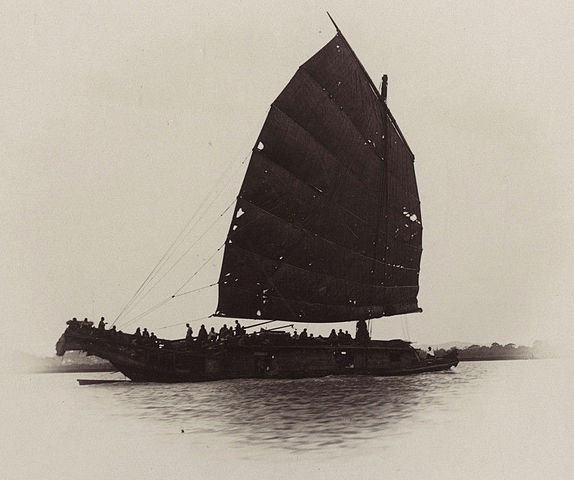
Photo is scan of old print by Lai Afong [CC BY-SA 4.0 (http://creativecommons.org/licenses/by-sa/4.0)], via Wikimedia Commons
The battens also provide points of attachment for one or more downhauls. Simple sails have fewer but it is possible to have as many downhauls as there are battens. These downhauls simplify reefing. There is no need to tie up the reefed parts of the sail. The halyard is loosened, the sail lowers because of the weight of the battens, or is pulled down, the new downhaul from a higher batten is fastened and the halyard is made tight. Simple and quick sail reduction on all points of sail.
Since each batten is fastened to the mast using lines or parrel beads, the sail is better controlled.
Lazy Jacks take up the reefed or lowered sail
All Junk rigs have robust lazy jacks that controls the sail as it is lowered and keep the reefed sections out of the way. Unlike the western balanced lug, the top of the rig is controlled as it is lowered and falls into the lazyjacks without much argument.
The Junk Rig has a halyard
The halyard used on a junk rig has to be quite a sturdy affair and often has blocks and winches to raising the quite heavy sail.
What are the advantages of Balanced Lugs including Junk Rigs?
The balanced lug sail has long been used by pleasure boaters and the reasons are compelling.
- As in all square sails, you can put up a lot of sail on a shorter often unstayed mast.
- Because part of the sail lives in front of the mast, it is light to sheet and control.
- For the same reason, jibing is less of an issue than in sails that are all behind the mast. The feared accidental jibe is not as dangerous as in other rigs.
- It is simple to keep a good shape on all points of sail.
- Reefing is quite simple and can be done while underway.
- Even while heavily reefed, the sail still remains balanced. The centre of effort hardly shifts.
- It is a relatively simple sail to make.
- It is docile easily controlled sail.
There are a few disadvantages in the use of Balanced Lugs
- Unless lazy jacks are set up it can ungainly to lower. Since the sail is not laced on its sides it can flop around and billow.
- The yard end pivots down from the mast and points downward as it is lowered or the sail is reduced. It does not necessarily fall into the lazyjack easily and often has to be grabbed and controlled as it sways and bounces around.
- Sail can twist at the top.
- The luff in front of the mast, has to be quite strong because it is subject to a lot of tension from the yard which acts as a lever balanced at the mast.
- Like many of the other square sails, there is a good tack when the mast is on the front of the sail, and a bad tack where the mast is behind the sail and distorts the shape. In practice this is not as important as it would first seem to be. In my Sprit sail, the "bad" tack is sometimes faster. To eliminate this disadvantage, if the boat has more than one mast, the sails are attached in an opposite side so that there is always one sail with a good tack.
Most of these disadvantages have been eliminated in the junk rig.
What advantages and disadvantages does a Junk Rig Bring.
Upside of Junk Rigs
The junk rig benefits from all the Western Balanced Lug advantages and a few of its own.
- Because of the large number of battens the sail is divided in many sections which can be individually controlled. Superior control is the greatest advantage of the Junk Rig.
- There is no need to round up and put the nose in the wind to lower sails. Because of the battens there is no fluttering of edges either.
- Each small sections is attached to the mast and acts as a small sail. This reduces the stress on any one spot of the sail. Any stress is much better distributed than in the Bermudian rig. Many junk boats had sails made of woven reeds or quite light fabric. This also means that if a section is damaged this is not propagated to the rest of the sail. Any old picture of junks will show sails often with a considerable number of holes and repairs.
- Junk rigs have lines from the end of each of the battens and this provides very accurate control on how the sail sets. Unwanted twist is practically eliminated. Twist is sometimes encouraged as a means of adding shape to a flat sail.
- The weight of the battens allow the sail to be reefed or taken down quite easily from all points of sail. The weight tensioning the sail while it is lowered. This stops the yard and other battens from pointing downwards and flopping around. In some rigs there are even downhauls from all the battens.
- The lazyjacks or topping lifts control the sail as it goes down and the sail folds itself safely without much human intervention. Because of all the control lines at the end of the battens, the top yard is controlled and stays in position ready to fall quietly into the lazy jack as do the other battens. Have a look at the end of this Youtube video where the sail is being lowered.
Downside of Junk Rig
All this control and safety comes at some cost.
- Extra cost is one of these. There are a lot of details on a junk rig.
- The rig is heavier than most. This means that even a relatively small sail is quite heavy to raise.
- With all the lines and blocks, it is more complex to set up. Once set up though it is no more complicated to get going than a bermudian rig.
- A traditional junk sail is flat and not as efficient as a shaped sail. Moving to winward in light wind is not easy. BUT if the sail has a fanned top rather than squarer, the top part of the sail can be allowed to twists and create some camber improving performance.
- Making a junk sail can be quite time consuming because there are a lot of little bits and bobs to deal with. There are attachment for the control lines at the back of the battens, for the lazy jacks, for the parrel beads or whatever method is used to tie the boom/battens to the mast, lots of chafing gear, lacing for the battens, attachment for the downhauls (sometimes placed on each batten). There are lots of blocks, grommets, roping and lines. All this adds up.
- Anywhere on a boat where there is a line, there is a chance it will get fouled up.
Modern junk Rigs have improved performance.
Modern junk rigs have been modified from traditional shapes to improve the set of the sail and provide additional lift.
Traditionally, the sail is cut flat. There are no curves or difference in seams (broadseaming) that add shape to the panels.
By modifying the shape of each little rectangle so that there some curve to the cut rather than just a straight line where the battens attach, the individual panels can be made to have shape and improve performance
Wikipedia article on the Princess Taiping which sailed from Taiwan to San Francisco and almost all the way back, she collided with another ship just a few kilometres from Taiwan. This voyage nevertheless demonstrated the seaworthiness of the junk boats and rigs.
More Junk Rig Links and Information
Because of the stellar qualities and success of the junk rig, many sailors are trying them out.
One of the complaints that recur about junk rig boats is how rare and difficult to buy they are. The junk rig association has a for sale section as well as many links and a forum
Many people have taken their junk rigged boats on extensive cruises and have written about the experience:
- Annie Hill sailed Badger and wrote "Voyaging on a Small Income." Her ship was designed by Jay Benford
- Roger Tailor has crised extensively in his Mingmings. Here is a youtube video of MingmingII
- Joshua Slocum sailed Liberdada and wrote the "voyage of Liberdade"
- Blondie: The Life of Lieutenant-Colonel HG Hasler DSO, OBE, RM, founder of the SBS and Modern Single-handed Ocean Racing
" target="_blank" title=""> Colonel H.G. (Blondie) Hasler sailed and took second place in the first singlehanded transatlantic race in a Swedish folkboat named Jester. This is a biography.
- Kasten Marine has a nice article Good diagram of how the front lines come together to a single line.
- Tom Colvin's Gazelle is the stuff of legends.
- Cruising Ashiki is an interesting blog Lower in the page there is some discussion and photos of panels with cambered sail vs completely flat junk sail.
- The must read book is Practical Junk Rig Design Aerodynamics and handling by Hasler and McLeod.
- Good Tutorial on Junk rig in the Cheap Pages.com
 " target="_blank" title=""> Colonel H.G. (Blondie) Hasler sailed and took second place in the first singlehanded transatlantic race in a Swedish folkboat named Jester. This is a biography.
I try to be accurate and check my information, but mistakes happen.
email me if you find mistakes, I'll fix them and we'll all benefit: ChristineEmiliano Marino speaks highly of Junk Rigs in his book
Sailrite has supplies and sewing machines for sailmaking
Nautical terms referring to sails
Small Print
This information is for general knowledge and entertainment. I was interested and wrote up my notes for anyone who was also looking at junk sails. I'm not an expert, just a curious george.